Table of Contents
How to do Facebook ads in 2026
Step 1: Define One Campaign Goal
How to do Facebook ads in 2026
Start with this one question:
What would I like people to do as a result of seeing this ad?
For example:
- Go to my website.
- Message me on WhatsApp.
- Submit a lead form.
- Buy from me.
- Download my app.
- Interact with my content.
- Discover my business.
How to do Facebook ads in 2026
Do not pick the objective that seems to be popular.
Pick the objective that is closest to your real business objective.
How to do Facebook ads in 2026
Simple objective guide
How to do Facebook ads in 2026
| Business goal | Objective to consider |
| Build awareness | Leads |
| Awareness | Promote an app |
| Get website visitors | App promotion |
| Traffic | Make sales |
| Get interactions | Sales |
| Engagement | Have conversations |
| Collect enquiries | Consider Engagement/Leads options and messaging destinations available |
How to do Facebook ads in 2026
Meta’s current campaign structure is different from the older recommendations found in many outdated Facebook Ads tutorials. If an old tutorial suggests you pick objectives like “Conversions,” “Video Views,” or “Messages” as individual top-level objectives, please refer to the Ads Manager UI rather than follow the outdated article.
How to do Facebook ads in 2026
Step 2: Identify Target Audience
Do not target “all Indians” because your budget is limited.
How to do Facebook ads in 2026
Start with your most likely customers.
Define:
Location: In which location can you really deliver your services?
Age: Which age groups are really relevant?
Problem: What problem does your customer have?
Offer: What are you selling/booking/downloading/enquiring about?
How to do Facebook ads in 2026. Customer intent: Is this product actively sought or discovered when browsing? In the case of a local business, location matters more than hundreds of interest additions.
For example, a cleaning business operating from Kochi can start with targeting people from its actual service area and not the whole state.
The targeting should remain relevant, but do not assume that the addition of hundreds of interests will improve your performance. Meta’s automated audience and delivery systems may impact the selection of the audience in particular cases based on the selected campaign settings. How to do Facebook ads in 2026
Step 3: Select Meta Ads Manager
For a serious test of Facebook Ads, choose Meta Ads Manager, not boosting the post.
How to do Facebook ads in 2026
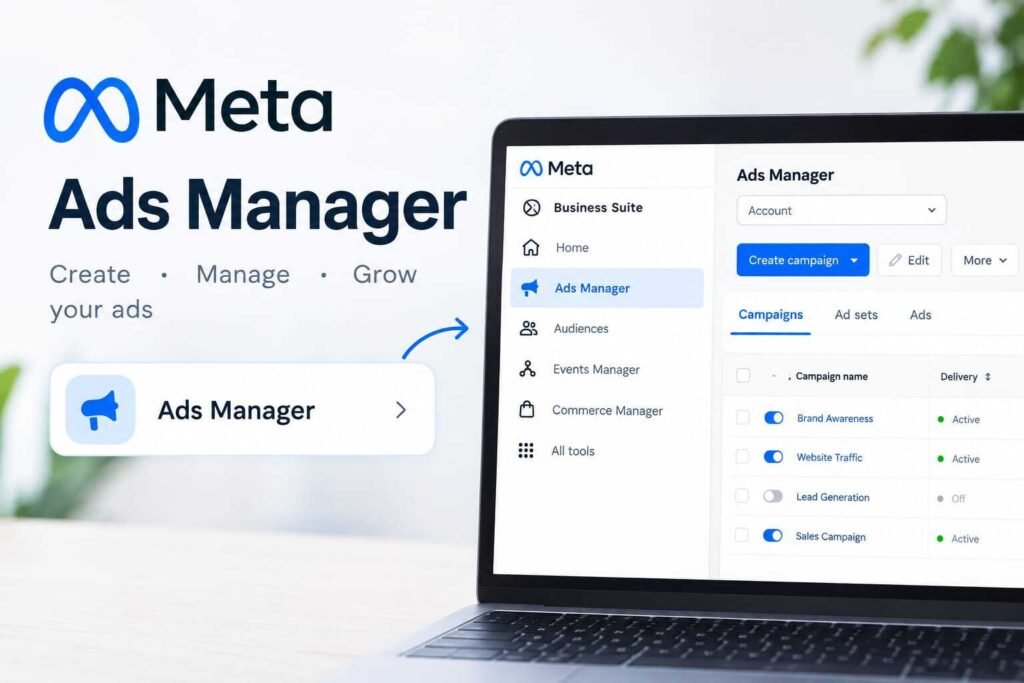
The post boost feature allows promoting an existing post conveniently and quickly. But it provides less control over campaign structure, objectives, target audience, budget, placement, ad creatives and reporting capabilities.
Meta’s current Ads Manager flow includes creation of campaign, selection of objective, configuration of campaign/ad set settings, selection of placements and creation of an ad.
Beginner recommendation: Go for Ads Manager if you want to understand Facebook Ads properly.
How to do Facebook ads in 2026
Step 4: Establish Your Company’s Identity
Depending on the nature of your business, a Facebook Page and the relevant business assets might be required. How to do Facebook ads in 2026
It’s important to ensure your business information appears credible:
Business name
Profile image/logo
Description
Contact details
Location
Website or other promotional media
Relevant recent content when available
An Instagram account is not mandatory in order to use Instagram placements. Meta claims that one can use a Facebook Page for an Instagram ad.
However, linking an Instagram account is more beneficial if Instagram is a relevant marketing channel for a business.
How to do Facebook ads in 2026
Step 5: Set Up Meta Ads Manager
Access Meta Ads Manager and make sure you have:
- A relevant Facebook Page
- The advertising account
- A working payment option
- Relevant permissions
- Your website, tête-à-tête platform, lead generation form, or another conversion resource is ready.
In case of working with an external contractor, account and business permissions must be used instead of disclosing personal credentials.
How to do Facebook ads in 2026
Step 6: Select the Campaign Objective
At this stage, create your campaign.
How to do Facebook ads in 2026
Your choice highly depends on what you sell, considering the budget of ₹1,000.
Traffic
Low-friction offers Traffic when your immediate goal is to get people to your website or other destination and see if your ad is capable of attracting visitors. How to do Facebook ads in 2026
It is suitable for:
- Blog content
- Service pages
- Educational content
- Low-friction offersLeads
- Consider
Leads
when it comes to getting enquiries, registrations, or contact details. How to do Facebook ads in 2026
Applicable for:
- Local services
- Coaching
- Consulting
- Real estate
- B2B services
- Engagement
- It is useful when the goal is interacting with the content or taking other engagement actions that are available within the current settings.
How to do Facebook ads in 2026
Sales
Use Sales when there is a real purchase journey and the proper measurement setup.
Do not select Sales for just any small campaign because you think it is going to get you the sales. If your store does not have traffic, conversion history or has complicated checkouts, the investment of ₹1,000 will not help gather enough data to analyze the funnel properly. How to do Facebook ads in 2026
Messages
If the business closes the clients via dialogs, the output can be possible through messaging. Ads that can start the dialogue are available through Meta for such tools as Messenger, Instagram, WhatsApp and etc. How to do Facebook ads in 2026
Step 7: Choose Your Placements
Meta offers advertising within its ecosystem of products and gives suggestions
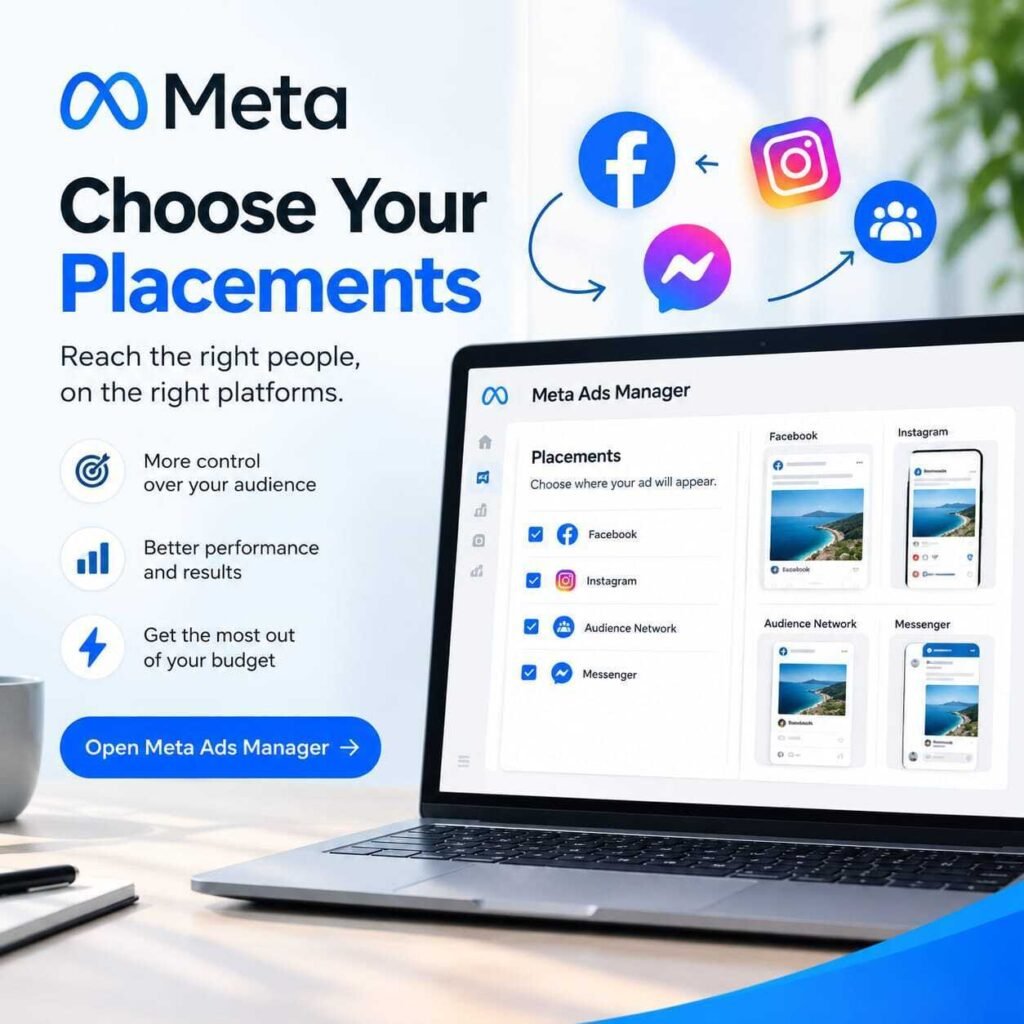
In many campaigns, Advantage+ placements can automatically distribute ads across eligible placements to find opportunities for your objective. Meta recommends Advantage+ placements as a way to give its delivery system more opportunities to use the budget efficiently. How to do Facebook ads in 2026
For a beginner with ₹999, I would generally start with the recommended automated placement setup unless you have a specific reason to restrict placements.
Why?
Because manually restricting your campaign to one placement can unnecessarily limit delivery.
However, review your creative carefully. A horizontal image that looks good in a Facebook Feed may not look good in a vertical Reels placement.
How to do Facebook ads in 2026
Step 8: Create the Ad Creative
Your ad creative is often more crucial than most beginners expect.
There is no need to hire an expensive production team.
You could create a great ad using images taken by your smartphone, some basic demo of your product, a talking head video, before and after pictures, screen recordings, or simple footage/graphics. How to do Facebook ads in 2026
An ad creative should communicate:
What is it?
Who is it for?
Why should one care?
What should one do next?
A simple formula for an ad is:
Problem → Promise → Proof → CTA
For example,
“Still spending time creating
Drop us a message to talk to us about your business.”
Be careful not to fill up the ad creative with small font text, lots of offers, and 5 different messages.
An ad should communicate one idea loud and clear.
Step 9: Write the Main Text, Heading, and an Action Point
Your text doesn’t need to sound like an ad.
Main text
You should concentrate on the problems your prospective clients have.
Heading
Your offer should be clear and concise.
Examples:
- “Free 15-minute Consultation”
- “Healthy Meals Delivered Locally”
- “Get Your Website Audit”
- “Custom Cakes for Your Next Event.”
CTA
Pick a CTA for the action
Step 10: Set a Budget of Less Than ₹1,000
For the test campaign, use a maximum total budget such as ₹999.
A simple approach is:
₹999 total over 7 days = about ₹142.71 per day on average.
Using a lifetime budget can make the total test budget easier to define when that option is available in your setup.
Do not assume that every campaign will spend in the same way every day. Meta’s budget and delivery controls can vary by campaign configuration.
The important rule is:
Step 11: Pick a Campaign Length
For a small test, 5–7 days is a reasonable starting window.
This is not to say that each campaign should span out for precisely seven days.
How to do Facebook ads in 2026
A campaign may take longer if:
- You are targeting a very niche audience
- You have a long buying cycle
- You need multiple touchpoints before a customer converts
- You need more conversion data.
- Decide on a maximum amount that you are truly comfortable with spending before you publish.
- Also remember that taxes or any other surcharges may affect your final amount; make sure to double-check the amount shown in your account.
However, this doesn’t mean that you should run a poor campaign simply because you planned to run it for 30 days in advance.
With only ₹999, a long campaign may spread the learning too thin.
Step 12: Start the Campaign
Just before hitting Publish, make sure to review:
- Targeted objective
- Targeted location
- Targeted audience
- Targeted budget
- Targeted time table
- Targeted Page/Instagram account
- Targeted URL
- Targeted call to action
- Working landing page
- Correct grammar in the ad
- Ad is appealing and high-quality on mobile version.
Step 13: Measure Results
Avoid checking the Ads Manager every five minutes.
Instead
Give the campaign enough time to collect meaningful data.
Look at:
- Reach
- Impressions
- CPM
- CTR
- CPC
- Engagement
- Leads
- Cost per lead
- Conversions
Facebook Ad Metrics in Easy Words
| Metric | What it means |
| Reach | Number of people who saw your ad |
| Impressions | Total number of times the ad was displayed |
| CPM | Cost per 1,000 impressions |
| CTR | Percentage of impressions that resulted in clicks, depending on the CTR definition shown |
| CPC | Average cost per click |
| Engagement | Interactions such as reactions, comments, shares, or other measured actions |
| Leads | People who completed the lead action you configured |
| Cost per lead | Amount spent divided by leads generated |
| Conversions | Valuable actions such as purchases, registrations, bookings, or another configured conversion |
Don’t obsess over industry-wide benchmark numbers.
A 3% CTR is not automatically “good,” and a ₹20 CPC isn’t automatically “bad.” Context matters.
Compare your results against your own campaign goal and economics.
How to execute the campaign worth INR 999.
Let’s assume that you are running a small business graphic design service.
Campaign setting
Budget for the campaign is INR 999.
Duration is 7 days.
Average daily spending is INR 143.
Place is the area you serve.
Target audience is representatives of small businesses who would potentially need your design services.
Goal could be to generate leads or to get them to message you.
Creative part consists of the very
The most effective Facebook Ads methods in 2026 will be determined based on the organization and its goals rather than budget only.
If you are a local service provider
Use Leads or Messenger as your ad type if your service requires inquiries before closing the deal.
Examples include a plumber, dentist, beauty salon, house cleaning, tutor, or photographer.
If you operate an e-commerce store
Consider Sales if you have a store/product catalog with checkout and measurement readily set and properly working.
Spending ₹1,000 on testing may serve as testing a powerful product/creative rather than proving the whole funnel.
Message or leads-based suitable for the campaign set up.
What should you expect?
Do not wait for a specific number of leads.
Instead, assess the levels of the campaign:
Level 1: Do people see the ad?
Level 2: Do people engage with the advertisement?
Level 3: Are people making clicks, messages or forms?
Level 4: Are inquiries relevant?
Level 5: Are you able to convert inquiries properly?
Campaign costing ₹999, which derives a few meaningful conversations can reveal to you how to use leads or messenger considering that
7 Tips For Reducing Wasted Facebook Ad Spend
1. Avoid Broad Targeting
Instead of targeting all of humanity, target a well-defined audience. For local businesses, understanding geographic relevance becomes crucial.
2. Test One Variable At A Time
Don’t change everything at the same time:
- Audience
- Creative
- Offer
- Landing page
- CTA
If everything is changed at once, you cannot determine the source of difference.
3. Use Effective Creatives
Good offers can fail if presented badly.
Show the product. Show how the service works. State the end result.
4. Optimize the Landing Page or WhatsApp/ Messaging Experience
Your ad is only part of the entire funnel.
If you are a coach or consultant
Your type of ad
Free Design Review for Social Media.
CTA
If the ad information does not match the landing page content, the audience will leave.
5. Do not spend all funds before examining performance.
Keep an eye on the campaign from time to time.
If it is clear that there is a serious issue such as bad destination, wrong audience, bad creative, and poor traffic, remedy the situation first instead of wasting more money.
6. Don’t Make Decisions Based on Incomplete Information
Just because you’ve received one click doesn’t mean you learned anything.
And a solitary day won’t be of much help either.
Put your efforts into establishing patterns rather than reacting to every single day’s results.
7. Increase Budget Only When the Economics Are Justified
In case an ad results in responsible leads and you can profit from them, then consider gradually raising the budget.
The point in scaling up is not how inexpensive the ad may be.
Instead, you should ask yourself:
“Can I afford to get a customer from them for a reasonable amount of money?”
5 Easy-Follow Facebook Ad Examples
1. Local Service Business
Business: House cleaning service
Objective: leads
Creative: Short before-after video
Offer: Free estimate for cleaning
Audience: around the area offered by the service
CTA: Ask for information
2. Online Shop
Business: Hands-made cosmetic company
Objective: sales
Creative: Video with demonstration of a goods
Offer: Only one product or package
Audience: potential customers
CTA: Shop Now
t3. Restaurant
Business: Local dining establishment
Purpose: Attracting customers, generating traffic, or achieving some other marketing goal related to sales.
Creative Idea: A video
Offer: Specific meal, promotion, or ordering opportunity.
Target audience: Local customers.
Action: Visit or order.
Avoid covering the whole menu briefly in the advertisement. Pick just a single compelling reason to dine at or order from your establishment.
4. Coach or Consultant
Business: Career consultant or coach.
Goal: Lead generation.
Creative: A talking-head video with a common career question answered.
Offer: A free introductory consultation.
Call to Action: Sign up.
The advertisement must be aimed at qualifying people who are looking for career advice in general.
5. Freelancer
Business: Freelance webpage designer.
Goal: To get leads or messages.
Creative: Showcasing how the web page was redesigned.
Offer: A free homepage review.
Call to action: Send message.
Doing it would be effective in case the freelancer has a clear target audience it serves—restaurants, medical institutions, or other local businesses.
Common Facebook Ads Mistakes Made by Novices in 2026
Mistake 1:
Relying on outdated tutorials
The Facebook ads system is changing all the time.
Old objectives, targeting options, and systems may be useless.
Mistake 2:
Making an objective based on vanity metrics
3. Restaurant
Business: Local dining establishment
Purpose: Attracting customers, generating traffic, or achieving some other marketing goal related to sales.
Creative Idea: A video
Offer: Specific meal, promotion, or ordering opportunity.
Target audience: Local customers.
Action: Visit or order.
Avoid covering the whole menu briefly in the advertisement. Pick just a single compelling reason to dine at or order from your establishment.
4. Coach or Consultant
Business: Career consultant or coach.
Goal: Lead generation.
Creative: A talking-head video with a common career question answered.
Offer: A free introductory consultation.
Call to Action: Sign up.
The advertisement must be aimed at qualifying people who are looking for career advice in general.
5. Freelancer
Business: Freelance webpage designer.
Goal: To get leads or messages.
Creative: Showcasing how the web page was redesigned.
Offer: A free homepage review.
Call to action: Send a message.
Doing it would be effective in case the freelancer has a clear target audience it serves—restaurants, medical institutions, or other local businesses.
Common Facebook Ads Mistakes Made by Novices in 2026
Mistake 1: Relying on outdated tutorials
The Facebook ads system is changing all the time.
Old objectives, targeting options, and systems may be useless.
Mistake 2: Making an objective based on vanity metrics
Is it possible to use Facebook Ads if I don’t have a website?
Yes, it depends on the goal of your campaign and the objective you choose.
For instance, many businesses may choose to use lead forms or other messaging options instead of sending customers to a website. There are special ads recommended by Meta that may encourage customers to have conversations via Messenger, Instagram, or WhatsApp.
Facebook or Instagram ads: Which one should I choose?
If we consider things from the advertiser’s perspective, both advertising systems are part of Meta’s advertising family rather than entirely separate systems. One campaign might be displayed on both platforms.
How do I know that my ad works?
You should start from the objectives of your campaign.
If your objective is to generate leads, focus on the number of leads generated and the CPL
In case your objective is to generate sales, focus on the number of sold items and the economics behind the number.
In case your goal is the traffic, focus on qualified visits and actions carried out by customers after arriving.
Don’t judge the effectiveness of the ad based only on a low-cost per click or
Your first ₹999 does not have to actually turn you into a millionaire but should help you learn how to become smarter and understand what to test next.
Can you advertise using Facebook Ads without a website?
Yes, this is possible depending on the type of campaign that you are running and the destination of your advertisement. Businesses can run engagement ads instead of directing potential customers to their website. Meta offers numerous advertising opportunities to create messages on social media (Messenger, Instagram, WhatsApp, etc.)
Facebook Ads or Instagram Ads?
For most advertisers, it is better to see them as part of one Meta advertising ecosystem rather than as two separate advertising systems.
Your ad campaign can run here and there on Facebook and Instagram as needed.
The Advantage+ function will identify the best channels automatically.
How do you know if your ad was a success?
You have to start with defining your business goal.
If your goal is producing leads, you would check the number of leads produced and the costs per lead.
If your objective is to increase conversions, then you should monitor the number of sales made.
If your aim is to grow your traffic, you should check
In Step 4, it is important to create a business presence on various platforms. Based on your requirements, you might need a Facebook Page along with other assets.
Make sure your business information appears genuine, including business name, logo, description, contact details, location (if any), website and recent posts. There is no need of having an Instagram account in case of Instagram placement, according to Meta.
The page can be used to run ads on Instagram. However, if Instagram is an important medium for your business, it is better to connect your Instagram account for establishing a complete brand presence.
Step number 5 is to set up Meta Ads Manager. When using this program, you should make sure that you have a proper Facebook page, advertising account, valid payment method, business/account permissions and website or the other messaging destination ready in advance. If you work in cooperation with freelancers, use business permissions instead of sharing your personal Facebook login.
Step 6 is about campaign objective setting. For instance, if you are going to spend ₹1,000, this choice will depend a lot on your product. Traffic option can be used if you need to bring visitors to your website.
Traffic option will be effective
Step 9: Write the Primary Text, Headline, and CTA
The text you write doesn’t need to be written like it is an advertisement.
Primary Text
Concentrate on what the customer wants to solve or accomplish.
Headline
Make it easy for the customer to understand the offer.
e.g. “Get a 15-minute complimentary consultation” or “Enjoy freshly prepared meals at your doorstep”.
CTA
Decide on the CTA that corresponds with the action you expect the reader to take.
Don’t ask them to “Shop now” if you are trying to get them to consult.
Step 10: Set a Budget of Less than ₹1,000
In the case of conducting a test campaign, your budget should ideally not exceed ₹999.
A simple way would be:
₹999 total for 7 days = an average of around ₹142.71 per day.
If available, it would also be a good idea to opt for the lifetime budget, as that would make it easier to calculate the total amount you would want to spend for testing.
Never assume that every campaign will use a similar amount of money every day. Meta does have budget and delivery controls.
One rule to be followed is to ensure that you are comfortable with the total amount you are
Ensure that your ad campaign is launched after running a final check to confirm that:
- The objective of the campaign is correct.
- The locations are correct.
- The target audience is correct.
- The budget is correct.
- The schedule is correct.
- The identity of the Page or Instagram is correct.
- The ad destination is correct.
- The CTA is correct.
- The website or messaging medium is working.
- There are no spelling mistakes.
creative is correctly optimized for mobile.
tracking has been set up where necessary.
Facebook checks out each ad before it can be launched; don’t think that just because it is published it means it has gone live.
The creative side of an ad is more important than what many new marketers realize.
The ad may not require an overly high production value; instead, it can be any sort of a basic production, such as a smartphone photo, a straightforward demonstration of the product, a talking-head presentation, a before-and-after video, a screen capture, or any straightforward visual design.
The creative should answer four main questions:
1. What do I have?
2. Who is it for?
3. Why should it be considered?
4. What action is expected next?
The easiest way to write
If you are getting ready to introduce a new app into the market, use app promotion as your objective if the main aim is to achieve app installations or carry out app actions. There are already six goals in Meta advertising structure, which is why you can choose the objective according to what you would like to achieve in your business as opposed to the previous tutorial describing some previous system of objectives.
7 Suggestions on How to Save Money on Facebook Ads
1. Do Not Use Broad Targeting
Instead of targeting everyone who might potentially buy the product, make sure that you understand who your target customers are. When it comes to local businesses, geographic correspondence can be very important.
2. Test One Variable at a Time
Do not change the following at one go:
Audience
Creative
Offer
Landing page
Call to Action
In case you change everything, nothing will be clear about what caused the difference.
3. Use High-Quality Creatives
Sometimes it does not matter how much better your offer is, the ad can fail badly.
Make sure you show the product, illustrate the service, tell about the outcome, use the real customer problem.
4. Improve Your Landing Page or Messaging
Your marketing campaign does not solely consist of your advertisement. If your ad creates an expectation that is not met on the landing page, the user will abandon the process after the click.
If you are using messages as a communication tool in your campaign make sure that your reply is fast and that the conversation does not feel complicated.
5. Watch the Campaign Performance
It is absolutely necessary to evaluate the performance of your campaign regularly. If something is evidently wrong with the campaign (wrong destination, irrelevant audience, misleading ad, unqualified clicks), just fix it instead of wasting your money.
6. Avoid Using Insufficient Data to Make Decisions
The fact that somebody has clicked on your ad doesn’t tell you much. One day does not tell you anything either. Try to analyze data to find patterns, rather than making emotional conclusions based on single cases.
7. Increase Your Budget Only When It is Economically Justified
If the advertisement brings relevant leads and you can convert them into sales, you may increase the budget.
Nevertheless, it is a good practice to raise the budget only when there is an economic justification. You shouldn’t increase the
The Most Common Facebook Ad Mistakes New Advertisers Make in 2026
Mistake 1:
Using tutorials that are out of date
Meta’s ad platform is always being updated.
A tutorial that includes an old objective or old targeting may not be relevant to your account.
Mistake 2:
Picking an objective based on popularity
Getting likes does not equate to getting sales.
Be sure to choose an objective that will help achieve a business goal.
Mistake 3:
Targeting too many interests
Adding too many target audiences does not mean better results
Mistake 4:
Running 5 campaigns for ₹1,000
Spending ₹1,000 on campaigns, target audiences and ads can lead to meaningless tests.
Mistake 5:
Changing campaign every hour
Constantly changing the ads can make it difficult to measure whether ads are working.
Mistake 6: I
Ignoring the offer
Good advertising will not change a bad offer.
Mistake 7:
Driving traffic to a bad landing page
A good ad cannot rescue a landing page that has a confusing checkout process.
Mistake 8:
Measuring clicks instead of results
Clicking on an ad is only a first step as the outcome will only be known later.
Mistake 9:
Expecting ₹1,000 to yield results
The small budget will bring some signals about the success of the ad, but the results cannot
Mistakes in Facebook Advertising Made by First-Time Entrepreneurs in 2026
#1 Error: Using outdated materials
Meta has an evolving advertisement engine.
Using materials that refer to outdated objectives or targeting can be irrelevant for your project.
#2 Mistake: Selecting an objective based on its popularity
Just getting likes does not imply selling a service or a product.
Always select your objective according to the business’s needs.
#3 Error: Focusing on too many interests
Putting together a broad audience does not guarantee success.
#4 Mistake: Making 5 advertisements for ₹1000
Investing ₹1000 in ads, targeting and campaigns may lead to meaningless outreach campaigns.
This might lead to inconsistent results.
#5 Mistake: Changing campaigns every hour
By constantly tweaking the ad creatives, it becomes impossible to assess whether a specific advertisement was effective.
#6 Error: Overlooking the offer
Good advertising does not help solve the problems in the offer.
#7 Mistake: Directing users to the wrong landing page
A great ad cannot improve a bad landing page featuring a confusing checkout process.
#8 Error: Judging ads based on clicks only
Clicks are just an index; the results will be clear after a while.
#9 Mistake: Expecting results from ₹1000 investment
if you want to learn more about Facebook ads? Explore my website to more about How to do Facebook ads in 2026