Table of Contents
Social media marketing strategies are crucial for business owners aiming to build brand awareness, attract their target audience, and engage with them effectively. With the help of social media, startups, local shops, online retailers, and well-established corporations can reach their customers 24/7 and communicate with them conveniently.
However, simply creating business accounts and posting new content is not enough to improve brand awareness and sales. Companies need to carefully set their goals, research their audience, define the best social media platforms to focus on, choose the right types of content to post, and much more.
In this article, we will discuss the best social media marketing strategies that businesses can use to boost their online presence, engagement, lead generation, sales, and other important metrics.
Why Social Media Marketing Strategies Are Important for Businesses
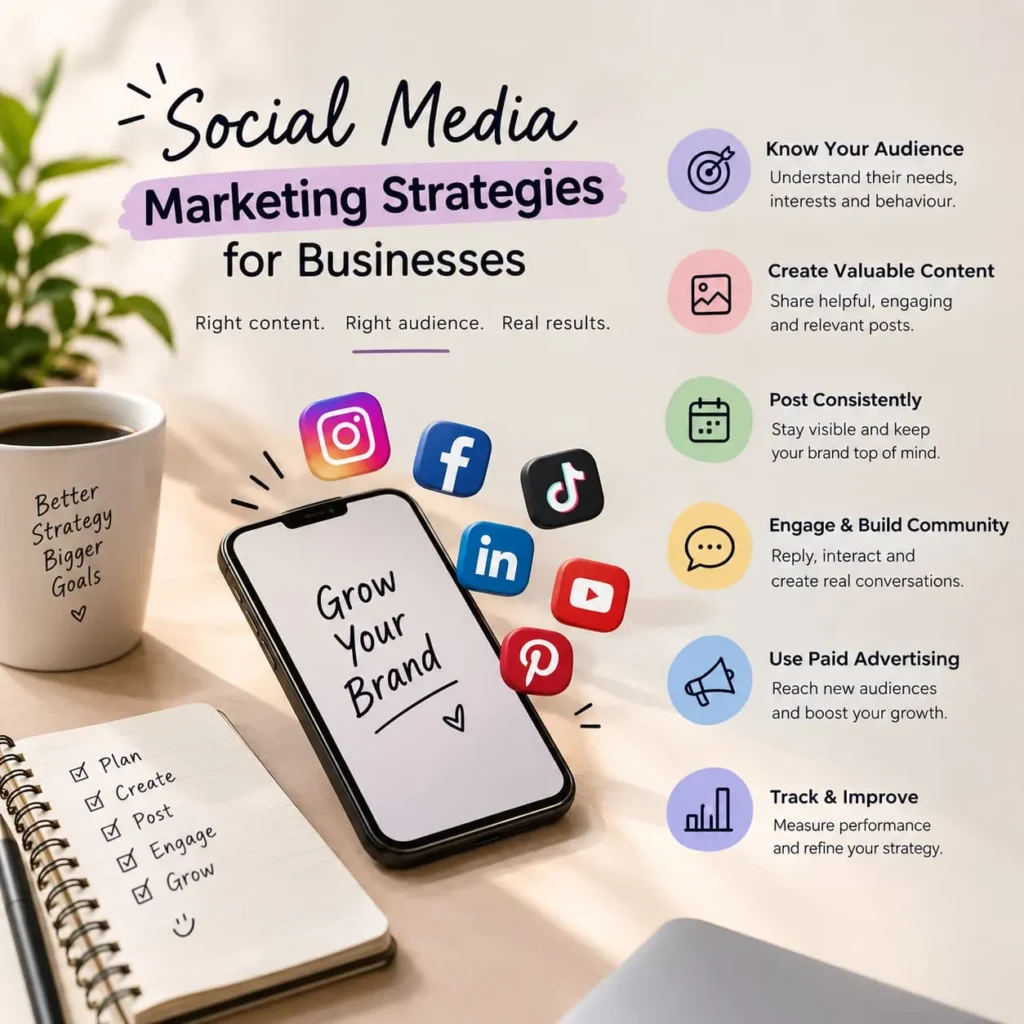
Social media is a great platform for businesses to communicate with their target audience. Instead of relying solely on traditional advertising, companies can post useful and engaging content and position themselves as experts in their field.
Developing effective social media marketing strategies enables businesses to achieve a variety of marketing goals. Some may focus on improving brand image and awareness, while others may aim to drive website traffic, generate leads, increase conversions, or improve customer relationships.
Businesses need to understand that social media is not simply a tool for overt selling. Instead, companies should offer solutions to their customers’ problems and position their products and services as the best options for addressing specific issues.
Companies can use various marketing strategies on social media. For instance, some may focus on educating their audience, while others may prioritize entertaining them. Businesses may also use influencer marketing, launch advertising campaigns, provide excellent customer support, and utilize other methods.
A social media marketing plan will depend on a company’s industry, audience, budget, size, and marketing goals. Therefore, there is no one-size-fits-all approach that can be applied to every organization. Even if two companies operate in the same niche and rely on similar strategies, they may use different platforms, approaches, and methods.
How to Build the Best Social Media Marketing Strategies
Before posting any content on social media, organizations should set clear goals. This will enable them to measure their results and determine whether their efforts are driving progress.
Businesses also need to keep in mind that each social media platform has different audiences and metrics. Therefore, the same strategy may work well for one company but fail when another business tries to use it.
Here are the main steps businesses should take when developing their social media marketing strategies.
1. Set Marketing Goals
Companies often try to measure everything on social media, which can be unfair and unreasonable. Instead, businesses should set specific, measurable, realistic, and attainable goals.
For instance, businesses may set the following goals:
- Increase brand awareness among the target audience.
- Drive more traffic to the company’s website.
- Boost sales by a specific percentage during a specific period.
- Double the number of engaged customers.
- Encourage more users to leave product reviews.
It is vital to remember that companies must set the goals that are most relevant to their business. For example, it may be impossible to significantly boost conversion rates and website traffic if a business has just launched and has very few visitors.
2. Define the Target Audience
Businesses should have a clear idea of who their customers are. They need to identify characteristics such as age, gender, occupation, and other relevant factors.
Companies may also group their customers according to their interests, behaviors, and other characteristics. This way, businesses can develop a better understanding of what type of content their audience is likely to engage with and what they would like to see on the brand’s social media accounts.
Information about the target audience enables businesses to create better social marketing strategies and more effective content calendars.
3. Pick the Most Relevant Platforms
Businesses should conduct market research and analyze which social media platforms their target audience spends the most time on.
It is usually better to focus on one or two social media platforms that the target audience actively uses rather than trying to maintain active profiles on every platform. This allows companies to maximize their efforts and potentially achieve better results.
4. Select the Type of Content
Companies need to define the types of content they will publish on their social media accounts. Businesses may create high-quality images or videos, write informative articles, publish engaging stories, hold contests, and much more.
The content should always be relevant, address the audience’s interests and pain points, and provide useful solutions.
It is also a good idea to respond to customers’ questions and comments to provide satisfactory support and strengthen relationships with the audience.
5. Pick the Brand Voice
A brand’s voice is crucial because it defines the company and helps build relationships with its audience. Businesses should strive to create a unique voice that appeals to their target customers.
A company’s voice can be playful, professional, funny, inspirational, or aligned with the nature of its industry. It should also be consistent with the brand’s visual appearance and overall identity.
6. Set the Publishing Schedule
Social media marketing requires a firm commitment, so companies should set their publishing schedules in advance.
Creating a content calendar enables businesses to know what they will post and when they will publish it. The schedule should be realistic and should not overload the marketing team. At the same time, it should be flexible enough to allow some freedom of choice.
Top 10 Social Media Marketing Strategies for Businesses
After defining their marketing goals and content strategy, businesses can start working on their social media content calendar. Here are some of the best strategies that companies can use on social media.
1. Create Content Focused on the Audience
Businesses need to conduct market research and analyze their audience’s preferences, behaviors, interests, and other relevant factors.
Companies should respond to the most common questions and address the most frequent issues faced by their audience. For instance, cybersecurity organizations can post tips about how to keep computers safe and avoid viruses.
This type of content can help build the company’s authority in its field and potentially drive leads and sales.
2. Utilize Short-Form Videos
Short-form videos are a great way to provide information to an audience. Businesses can use them to give useful advice, present their products and services, explain how products work, answer frequently asked questions, engage with their audience, and much more.
The first few seconds are crucial because companies need to capture viewers’ attention quickly. Businesses should also keep in mind that short-form videos need to provide genuine value to the audience.
3. Share Brand Storytelling
People tend to engage more with brands that have a unique story. Businesses can present their background and history, values, mission, and vision.
Companies can also tell interesting stories about their employees and products. Even though it is essential to be transparent and honest, businesses should not share every detail about their operations.
A strong brand story can help build relationships with the audience and increase customer loyalty.
4. Engage With the Audience Consistently
Many companies make the mistake of treating social media as a marketplace and focusing only on selling their products and services.
Instead, businesses should treat social media as a place for two-way communication. Companies need to actively engage with their audience by responding to questions, comments, and reviews.
This can help build stronger relationships and provide excellent customer support. Moreover, businesses can identify recurring questions and address them through informative content.
5. Publish User-Generated Content
User-generated content (UGC) is a great way to build trust with the target audience. Customers often enjoy sharing photos and videos of themselves using a brand’s products or services.
Moreover, UGC can be a helpful source of content because companies can repurpose it for their own social media channels.
Businesses should ask customers for permission before sharing their content on the brand’s social media accounts. This can make the audience feel like a part of the community and increase customer engagement.
6. Collaborate With Influencers or Creators
Influencer marketing has become one of the most popular ways to promote brands on social media. Businesses can collaborate with influencers and creators to reach a larger audience.
It is essential to choose influencers whose audiences are genuinely interested in the brand. The influencer’s field should align with the company’s niche, and their content should reflect the brand’s values and message.
Although an influencer’s follower count is important, businesses should consider other factors as well, such as engagement rates, credibility, content quality, and audience relevance.
7. Run Social Media Ads

Companies should consider investing in social media advertising to expand their audience reach through social media marketing strategies. Businesses need to define specific goals they want to achieve through their advertisements.
These goals should be realistic, specific, and measurable. For instance, companies may want to drive more traffic to a specific landing page, promote an upcoming sale, or encourage more customers to leave product reviews.
Businesses should analyze advertising data to determine which platforms perform better and which ones are more cost-effective.
8. Add Calls to Action to Social Media Posts
Many companies forget that they need to encourage their audience to take a specific action after viewing a post.
The call to action (CTA) will depend on the content of the post and the marketing goals the business wants to achieve. Some common CTAs include:
- Visiting the company’s website.
- Signing up for an email subscription.
- Contacting the company.
- Leaving a review.
- Sending an inquiry.
- Requesting a callback.
Adding a CTA to the end of a post can help convert the audience into leads or customers.
9. Repurpose the Most Popular Content
Businesses should keep track of their content performance and invest more time and effort into creating similar posts.
Companies can repurpose articles, blog posts, videos, and other materials. For instance, a high-quality long-form video can be turned into a carousel, social media post, blog article, infographic, or topic for email marketing.
It is important to analyze performance data, identify which posts performed well, and then modify and reuse that content in different formats.
10. Use Trending Topics
Trending topics, sounds, hashtags, videos, and memes can provide additional visibility for a brand.
Businesses need to keep track of popular topics that their target audience follows. It is essential to choose trends that are relevant to the company and create engaging content around them.
Businesses should not participate in irrelevant trends simply because they are popular. Doing so can waste company resources and fail to attract the right customers.
11. Create an Online Community

Companies can turn their social media audience into an online community and strengthen their relationships with customers.
Businesses need to facilitate conversations and encourage their audience to participate. They can reward the most active members of the community and create content that helps spark discussions.
This can enable companies to provide better support to their audience and increase customer loyalty.
12. Keep an Eye on Competitors
Social media marketing is highly competitive, and businesses need to stay aware of what is happening in their industry.
Organizations should keep track of what their competitors are doing and look for inspiration. Businesses can analyze the content other companies are posting, the marketing strategies they are using, and the audiences they are targeting.
Companies should not copy their competitors’ content. Instead, they should look for useful ideas and insights that can help improve their own content strategy.
How to Choose the Most Relevant Social Media Marketing Strategies for Businesses
Every company should carefully consider its marketing goals and develop the social media marketing strategies that align with its target audience, budget, and overall business objectives.
if you want to learn more about social media marketing strategies? Explore my website to learn more about social media marketing strategies