Table of Contents
Act as an experienced SEO content writer, SEO strategist, and digital marketing specialist. Write a comprehensive, informative, engaging, and SEO-optimized blog post on the topic “Why Is Your Website Not Ranking on Google?”
The blog will be published on my digital marketing website. It should help website owners, beginners, bloggers, entrepreneurs, and small business owners understand why their websites are not appearing on Google and how they can improve their search engine rankings.
1. Blog Content Requirements
- Blog title: Why Is Your Website Not Ranking on Google?
- Minimum word count: 3,500 words. Aim for approximately 3,800–4,500 words to ensure the topic is covered thoroughly.
- Primary keyword: website not ranking on Google
- Secondary keywords:
- how to improve website ranking
- Google ranking issues
- Internal linking keyword: digital marketing specialist
- Writing style: Professional, natural, conversational, informative, and easy to understand.
- Target audience: Website owners, bloggers, small business owners, entrepreneurs, startups, and beginners in digital marketing and SEO.
- Content quality: Original, unique, plagiarism-free, useful, and written for people rather than search engines.
- Language: Simple, clear English that beginners can understand.
- SEO plugin: Follow Rank Math SEO best practices.
- Search intent: Informational.
2. Keyword Optimization Instructions
Use the primary keyword “website not ranking on Google” naturally throughout the article.
Follow these keyword rules:
- Include the primary keyword near the beginning of the introduction, preferably within the first 100 words.
- Include the primary keyword in the H1 title.
- Use the primary keyword or a natural variation in relevant H2 and H3 headings.
- Distribute the primary keyword naturally throughout the article, including the introduction, main sections, troubleshooting advice, and conclusion.
- Use the secondary keyword “how to improve website ranking” in the introduction or an early section, in at least one relevant subheading, and naturally throughout the article.
- Include “Google ranking issues” in a suitable subheading and relevant paragraphs.
- Include the exact phrase “digital marketing specialist” naturally in a paragraph where readers can learn more about professional SEO and digital marketing services. Leave this phrase suitable for adding an internal link to my website page.
- Use related SEO terms naturally, including Google Search Console, technical SEO, keyword research, search intent, backlinks, on-page SEO, website speed, mobile-friendliness, indexing, crawling, content quality, and user experience.
- Avoid keyword stuffing, forced repetition, and unnatural sentences.
- Maintain a natural keyword frequency. Treat approximately 2% primary keyword density as a maximum target to evaluate rather than a requirement to force into every section. Prioritize readability and avoid over-optimization.
Important: Do not insert keywords where they do not make sense. Use relevant synonyms and variations to keep the article natural and useful.
3. SEO Title and Meta Description
Before writing the article, provide:
- An SEO title under 60 characters that includes the primary keyword or a natural variation.
- A meta description of approximately 150–160 characters that includes the primary keyword naturally and encourages users to read the article.
- A URL permalink using lowercase letters and hyphens.
- The primary keyword.
- The secondary keywords.
- A short excerpt of approximately 40–60 words for the blog listing page.
4. Blog Structure and Headings
Use the following outline as a guide. Expand each section with detailed explanations, practical examples, and actionable solutions to achieve the minimum word count.
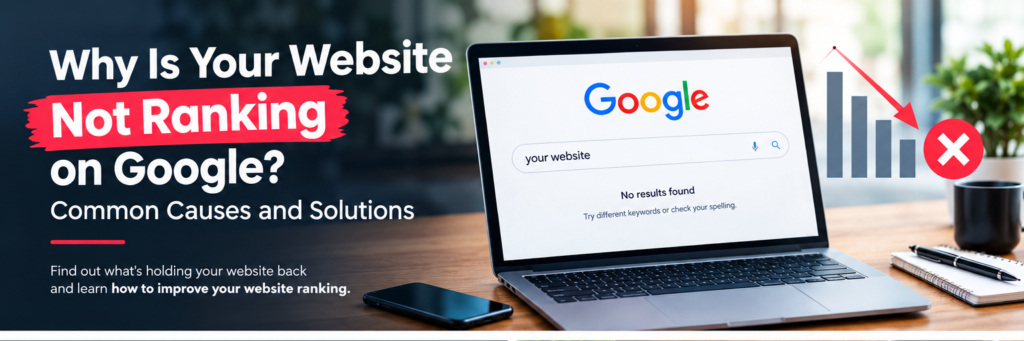
H1: Why Is Your Website Not Ranking on Google? Common Causes and Solutions
Write a compelling introduction that explains why a website may fail to appear in Google search results even after publishing content or investing time in SEO.
Include the primary keyword near the beginning, explain why Google rankings matter, and introduce the practical solutions covered in the article.
H2: What Does It Mean When Your Website Is Not Ranking on Google?
Explain what search engine rankings are, the difference between being indexed and ranking, and why a website might not appear for its target keywords.
Include a simple example that a beginner can understand.
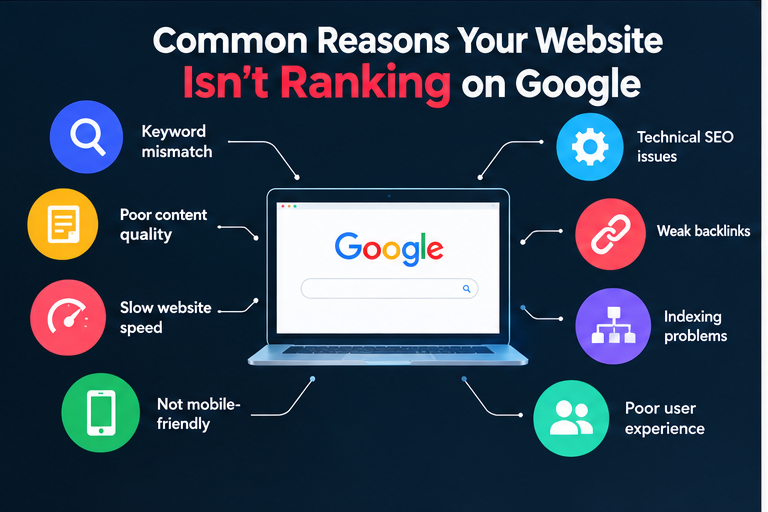
H2: Why Is Your Website Not Ranking on Google? 15 Common Reasons
Explain each reason in a separate H3 heading. For every issue, describe what it means, why it affects SEO, how to identify it, and how to fix it.
H3: 1. Your Website Is Not Indexed by Google
Explain crawling, indexing, and how to check whether important pages are indexed.
H3: 2. Your Website Has Technical SEO Problems
Discuss technical errors, broken links, redirect problems, XML sitemaps, and crawlability.
H3: 3. You Are Targeting the Wrong Keywords
Explain keyword research, keyword difficulty, search volume, and choosing keywords that match the audience.
H3: 4. Your Content Does Not Match Search Intent
Explain informational, navigational, commercial, and transactional search intent with examples.
H3: 5. Your Content Is Thin, Outdated, or Unhelpful
Discuss content depth, originality, accuracy, freshness, and satisfying the reader’s needs.
H3: 6. Your Website Has Poor On-Page SEO
Explain title tags, meta descriptions, heading structure, URLs, internal links, and image alt text.
H3: 7. Your Website Loads Too Slowly
Explain loading speed, Core Web Vitals, image optimization, caching, and unnecessary scripts.
H3: 8. Your Website Is Not Mobile-Friendly
Discuss responsive design, mobile usability, readable text, and Google’s mobile-first indexing.
H3: 9. Your Website Has Few High-Quality Backlinks
Explain backlinks, authority, relevance, natural link building, and why buying spammy links is risky.
H3: 10. Your Website Has Weak Internal Linking
Explain how internal links help users and search engines discover related pages and understand website structure.
H3: 11. Your Website Has Duplicate Content
Explain duplicate URLs, copied content, canonical tags, and ways to consolidate similar pages.
H3: 12. Your Website Has Poor User Experience
Discuss navigation, readability, intrusive pop-ups, accessibility, and making content easy to use. Avoid claiming that every engagement metric is a direct Google ranking factor.
H3: 13. Your Website Is Too New
Explain that new websites may need time to be discovered, indexed, and evaluated. Clarify that age alone does not guarantee rankings.
H3: 14. Your Website Has Security or Manual Action Problems
Explain HTTPS, Google Search Console security alerts, manual actions, and how to investigate genuine penalties or security issues.
H3: 15. Your Competitors Have More Relevant and Helpful Content
Explain how competitors may better satisfy search intent, cover topics more completely, earn relevant links, or offer a better user experience.
H2: How to Improve Website Ranking Step by Step
Provide a practical, beginner-friendly action plan covering:
- Finding the main cause of the ranking problem.
- Setting up Google Search Console and Google Analytics where appropriate.
- Checking indexing and crawl errors.
- Conducting keyword research.
- Improving existing content.
- Optimizing title tags, meta descriptions, and headings.
- Improving technical SEO and website speed.
- Making the website mobile-friendly.
- Building relevant internal links.
- Earning quality backlinks naturally.
- Monitoring search impressions, clicks, rankings, and conversions.
Explain how to prioritize these actions instead of trying to fix everything at once.
H2: How to Identify Google Ranking Issues Using Free SEO Tools
Explain the purpose and practical use of these tools:
- Google Search Console
- Google Analytics
- PageSpeed Insights
- Google Trends
- Google Keyword Planner
- Rich Results Test, where relevant
Include examples of what a website owner should look for in each tool. Explain which tools are free and avoid claiming that any tool guarantees higher rankings.
H2: How Long Does It Take to Fix Website Ranking Problems?
Explain why SEO results vary depending on the problem, website history, competition, content quality, and implementation.
Give realistic guidance without promising first-page rankings or guaranteed results. Distinguish between correcting a technical issue and seeing a measurable ranking improvement.
H2: Common SEO Mistakes That Prevent Your Website from Ranking
Discuss common mistakes such as:
- Keyword stuffing.
- Publishing AI-generated content without meaningful review or added value.
- Copying competitors’ articles.
- Buying low-quality backlinks.
- Ignoring mobile optimization.
- Publishing content without keyword research.
- Neglecting internal links.
- Expecting immediate results.
- Making frequent SEO changes without monitoring performance.
Explain how to avoid each mistake.
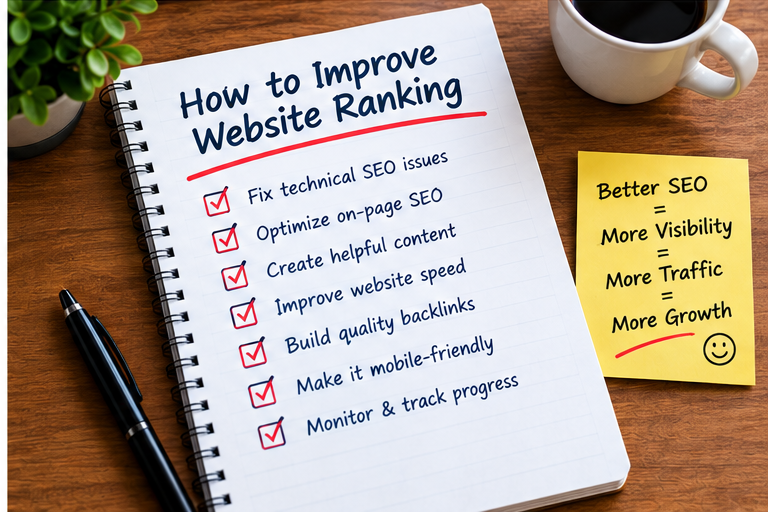
H2: Website Not Ranking on Google? A Practical SEO Checklist
Create a useful checklist readers can follow:
- Important pages are indexed.
- Google Search Console is configured.
- The website can be crawled.
- Target keywords match search intent.
- Content is original, helpful, and up to date.
- Title tags and meta descriptions are optimized.
- Headings are clear and logically organized.
- The website works well on mobile devices.
- Loading performance has been checked.
- Internal links connect relevant pages.
- Backlinks are relevant and naturally earned.
- Security and manual action reports have been checked.
- SEO performance is monitored regularly.
H2: When Should You Hire a Digital Marketing Specialist?
Explain when professional help may be useful, particularly for persistent indexing problems, complex technical SEO issues, declining organic traffic, competitive keywords, or a website migration.
Naturally include the exact keyword “digital marketing specialist” in a paragraph that can be internally linked to my digital marketing specialist service or profile page.
Do not make exaggerated claims or promise guaranteed Google rankings. Explain the value of audits, strategy, implementation, and ongoing monitoring.
H2: Frequently Asked Questions About Website Not Ranking on Google
Write at least 8–10 useful FAQs with concise, clear answers. Include questions such as:
- Why is my website not showing up on Google?
- How do I check if Google has indexed my website?
- How long does it take for a website to rank on Google?
- How can I improve my website ranking?
- Can a new website rank on Google?
- Does website speed affect Google rankings?
- Why has my website traffic suddenly dropped?
- Can poor SEO prevent my website from ranking?
- Are backlinks necessary for better Google rankings?
- How often should I update my website content?
Make the answers informative and suitable for readers who are new to SEO.
H2: Conclusion: How to Fix Your Website Not Ranking on Google
Summarize the most important causes of poor rankings and the practical steps readers should take first.
Naturally include the primary keyword and secondary keyword where appropriate. End with a kind call to action encouraging readers to review their website, follow the SEO checklist, and explore my digital marketing website for more SEO guidance.
5. Writing Quality Guidelines
- Write at least 3,500 words of actual blog content, excluding the SEO metadata and keyword list.
- Use a clear H1, H2, and H3 hierarchy.
- Write short paragraphs of around 2–4 sentences.
- Employ bullet points, examples, and tables wherever they improve clarity.
- Explain technical SEO concepts in simple language.
- Include practical examples relevant to bloggers, small businesses, service providers, and digital marketing websites.
- Avoid repetitive introductions, filler paragraphs, generic advice, and unnatural keyword placement.
- Do not copy or closely paraphrase existing articles.
- Add original explanations, realistic examples, and actionable recommendations.
- Do not invent statistics, case studies, research findings, or Google’s official statements.
- Distinguish confirmed Google guidance from general SEO recommendations.
- Do not promise a particular ranking position or a guaranteed timeframe.
- Avoid keyword stuffing and unnecessary repetition.
6. SEO Best Practices
Optimize the blog for readability and search intent while following current Google Search Central guidance.
Ensure the article covers:
- Search intent and keyword relevance.
- Helpful, reliable, people-first content.
- Indexing and crawling.
- On-page SEO and technical SEO.
- Mobile usability and Core Web Vitals.
- Internal linking and quality backlinks.
- Google Search Console troubleshooting.
- Content maintenance and SEO performance monitoring.
Where useful, suggest authoritative external links to relevant Google Search Central documentation, Google Search Console help pages, and PageSpeed Insights. Do not invent URLs or sources.
Suggest natural internal linking opportunities to other relevant pages on my digital marketing website.
7. Final SEO Review
After writing the complete blog, provide a short SEO review containing:
- Final word count.
- Primary and secondary keywords used.
- Approximate primary keyword density.
- Confirmation that the primary keyword appears in the title, introduction, and relevant headings.
- Suggested image placement and descriptive alt text.
- Suggested internal link anchor text, including “digital marketing specialist.”
- Three relevant external-link suggestions.
- A final readability and keyword-stuffing check.
Final instruction: Produce the complete, ready-to-publish blog in one response. Do not provide only an outline, a summary, or a short sample. Make the article genuinely helpful, original, comprehensive, SEO-friendly, and natural to read.